If you work at a large company with strong brands or a startup with no brand, to create a successful brand, you have to be capable of being a champion. To do that, you need smart brand positioning.
What if you have a great idea, but no authority on the topic? You must go get informed in a manner that helps you embody the most informed person in your brand’s area. There are no two ways about this, no shortcuts. You need the credentials and experience. If you can’t get those, you will need endorsements of those in authority. In order to get their attention, you will need some credibility of your own. If you’re doubting this, think about when you were a kid, when a classmate made some outrageous claim. What was our unfailing reply? Prove it.
Positioning Dilemma 1
Say you want to position yourself as an expert in women’s nutrition championing a new brand of foods aimed squarely at women. Sure, it’s a noble and worthy cause, but you lack relevant experience. Guess what happens when you start raising awareness? You will have potential opposition from doctors, dietitians, nutrition counselors, and anyone else with a strong opinion.
Granted, your experience may be unique and valuable, but will it be enough for you to speak with authority to the needs of your market? It might be, particularly if your unique experience relates directly to what you want to do. At some critical point, however, you will be asked to prove it.
Positioning Dilemma 2
Let’s think about it another way. Imagine you want to model for running shoe manufacturers. They want top runners, and fit average joes. And let’s say that you, in fact, are not fit and are not even a runner.
What would you be then? You would be a poser and an outsider, the antithesis of the proof people need to see in order to believe. You would lack the credibility needed to get any manufacturer’s attention, much less their ad agency, and you wouldn’t be able to relate to the market. In order to reach your goal, you would have to become a runner and get fit, which could take years. (Of course, you might be up for it.)
Brand Positioning Oversimplified
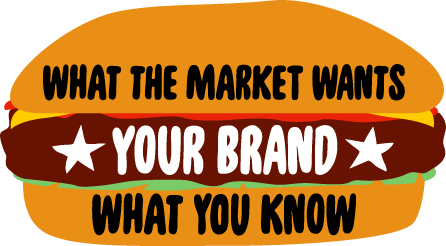
If you are like many entrepreneurs, you want to start a company or brand because you have something unique to bring to market. All you have to do for good brand positioning is make a sandwich.
The top slice of bread is what the market wants and needs, and the bottom slice, the foundation, is what you know. Your product is the middle, the heart of the sandwich (your brand), the reason people choose it and eat it up. And the condiments, lettuce, and cheese? Oh, that’s pure marketing.
Positioning around what you know will make your job easier. If you have credentials and relevant experience, you have a huge head start. Figure out what people want, match it up with what you can offer, and put in the hard work to make it reality.
Good brand positioning makes the difference between failure or success. Positioning around what you know is a critical step towards the latter.
There are two types of brand romantics in the working world, the believers and the paycheckers, and most every organization has both in their ranks, playing the role of inherent marketer.
The good romantics, those who help companies make millions and feel good about it, know how to craft reality into compelling stories people can connect with. The poor ones on the other hand, are romantics who know how to sell themselves in the course of crafting average actions and stories that average people may or may not connect with. The poor ones place emphasis more on making their sale, less on yours.
Internally, every employee is a marketer in one way or another. Employees are either believers or paycheckers. They are working for you because they believe in the company vision and its products, or they are there simply to collect a paycheck. Paycheckers are masters of disguise, while believers are masters of truth. Paycheckers get things done because it’s their job, while believers get things done and constantly strive for improvement because they believe in your brand.
How Paycheckers Drag You Down
The world is full of paycheckers because there are not many truly necessary and compelling products relative to how many workers there are. Paycheckers do what you tell them. They can say that they believe if you tell them to believe, but true belief is in the blood and the bones, and it can’t be acquired with mere telling or employee handbooks.
Paycheckers drag your brand and company down because their dialog is rarely as convincing as it must be, taking an often invisible toll on everyone’s efforts and projecting that outward like a toxic gas.
What people often do not realize about brands is that they are as much related to subtlety as they are about the overt, as much about the verbal as they are about the visual, and as much about the interactions as they are about the buying action. That means everything they do is a reflection of you.
Paycheckers rarely understand the deep significance of this fundamental difference because they are there first to collect a paycheck and second to represent. They’ve got it backwards, and while the difference is subtle, getting it turned the other way round often requires changing their personal core needs, which can be next to impossible without good psychological work (which you rarely can ask people to undertake) and particularly without leading by example, which I will explain further below.
Of course, everyone needs to be paid, but as a core part of their belief in you, believers understand that nudging brand representation in front of personal needs will yield greater brand value and, as a direct result, greater job security and personal well-being. There is a leap in that equation that requires faith in you. Some paycheckers can acquire it and some can not.
How True Believers Support Success
If your product and vision are among the relatively few great, you already have a head start, and if you already have a staff full of true believers, your head start is massive in nature. Not only can you attract talented people who will believe in you, but your people will give you their best efforts every day, always keeping your brand’s value in mind as a priority in everything they do.
Each person on your team will have the capacity to talk about your brand with a convincing tone, and to act as an ambassador for incoming employees, customers, vendors, partners, and anyone else. They are true believers who understand and believe in your vision and products, and they work every day to help you maintain and improve it by being true.
Believers can’t be caught out because they show their belief in every effort, every communication, every interaction, whether or not the effort is a success, a failure, or somewhere in between. Everything they do and say reflects the romantic side of their personality, literally that professional ethic inside of them, the feeling they have for their own motivation and actions, and how they communicate with the rest of the world about your brand.
How to Convert Paycheckers into True Believers
You might have some paycheckers on staff who you really like, you want to see them succeed, and you believe in their ability to help you succeed. They have done some good work, but you feel like you’re not getting the fullness of their capability. That can mean they have a doubt that needs to be fixed by a better experience, something they need to see and feel in order to develop that critical intrinsic belief about you.
The good news is that some paycheckers can be converted over to true believers. All they really need is to have those parts of their psyche that contain fears and doubts born of interactions reinforced with new interactions that overwrite current beliefs. For some it will be a quick conversion, born of one or two small changes. For others who possess more doubts, it may take time.
Converting paycheckers into true believers is all about making sure everyone around them is leading by example, representing your brand in the truest manner and with complete consistency.
Why You Must Lead Believers by Example
People believe in brands when they believe in the people who create and run them. That means you have to be at your best whenever possible, and you have to be real. You have to embody the positive qualities that people hold dear to their own happiness and well-being. You have to possess an understanding of those factors within your company, manufacturers, distributors, and customers, and you have to be able to represent them in a way that is true to your beliefs. You get out what you put in. You have to trust people, and when you do, they will trust you. Two-way trust results in people giving the best parts of themselves to their work, which shows they love what they are doing in helping your brand succeed.
This is where objective introspection becomes paramount. If you are a leader who is lacking in some subtle way, you may be unaware of how your smaller actions and words effect others. For instance, if you lack trust, or have a habit of utilizing belittling words, or over-share your personal problems, that can have a direct effect on people’s confidence in you and your organization. And maybe it’s not you, but rather your brand’s lack of outward character that is undermining their belief in you. Remember, your brand is a direct reflection of you.
A strong brand starts at the core, from within you, then extends to your organization or team, and radiates outward to consumers. It is critical to start at the center and build out belief in a radiating manner. When you do that, you can see the brand grow organically, which in turn infuses your marketing with a healthy core, keeping it true and believable, which helps people easily connect with your products.
Here is an example that many business owners overlook: As inconsequential as it may seem, if you have a dirty office, that internally reflects on your brand because it subconsciously speaks to how you regard the people who work for you. It gives people a degree of doubt right at home, at the core, something extra to think about (in a negative way). A quick daily cleaning shows people that you keep a clean house. A clean house equals a clear mind. Brands have a tendency to grow when everything radiating from the core is clean, clear, and overtly positive.
More obvious places where your brand can inspire confidence include your product quality, brand identity, marketing communications, social media interactions, and customer service. All of these are directly influenced by you and your team.
When you bring the same awareness to the all aspects of your brand, from the smallest through to the most visible, people notice it, and it comes through in everything they do, talk about, and buy.
We are all romantics, all marketing to ourselves. When you give people every reason to believe, you appeal to their romantic side, and it will come as a welcome reward that they place their belief in you.
Psst, lean your shoulder in. I’m going to tell you a big branding secret that graphic designers and branding firms (like ours) keep safely tucked away in their minds, away from clients, away from you. Are ready? Here it is: There’s no such thing as branding. We made it up. We talk about it, promote it, teach you all about it, and do the powerfully inspiring work of defining the core character of your company that is branding. But yeah, branding doesn’t exist.
How can that be? Well, I’ll tell you.
When graphic design was in its infant years, it was all hand-painted, hand-drawn, and personal. It was the craft of artists, and as with nearly any artists trying to carve out a living, it was by no stretch of the imagination a way to earn a good living. People got by, did okay, but they were never considered professionals in the way that a doctor or lawyer might be, and they put in long hours to barely eek out enough to eat and pay the rent (and sometimes they couldn’t). There were a handful of good designers back then, and many average ones (a lot like now).
So how do you make a struggling existence into a comfortable, highly profitable one? You create branding. You might think that just saying, “We specialize in branding,” wouldn’t be enough to allow a graphic design firm to succeed at branding. The truth is, merely saying it is enough, and here’s why: relatively few businesspeople (and few graphic designers) actually know what branding is.
How can that be? Think about this for a second: If I ask you, ‘What is scorting?‘ How would you answer? You can’t provide an intelligent answer because you don’t know what it is. But I made it up, so I can describe it however I like. If I describe the service well enough, really sell you on it, your business will have to do it because you will know that all of your competitors are doing it too. It’s just like branding, except that branding has been in business vernacular long enough that it now has taken on meaning.
Where did branding start? On cows, literally. Cattle ranchers branded their cattle with a mark (well, they burned a scar with a hot iron) to show which cows were theirs and protect ’em from rustlers. Then, along came business savvy (hungry) graphic designers who adopted the practice for businesses (except we used ink and now computers).
Branding has created a separate category for design firms, and those of us who took up the challenge to do it well made a better living. We helped businesses connect better and prosper. But if we never promoted branding as a service, people would not ask for it. What they ask for is design. They know design is art, and art is valuable. But branding? What is that?
If I say the word ‘branding’ now, savvy business people know that it is the process of developing their brand. But most people—business people and designers alike—still do not know what branding means. So we teach, inspire, and connect the thoughts.
To many people, branding is a logo. For others, it’s advertising. Some people know branding is about laying the groundwork for how people will receive your brand, your company, or products. Some people think branding is a one-time proposition, while others think of it as something they do every day. Some people refer to their brand as branding.
Here’s the kicker though. Even though the design industry made it up, branding works. If it did not work, you would never have heard of Apple or Starbucks or Nike. There would be no such thing as category leaders because there would be nothing to categorize. You would not know about Wal-mart or Best Buy or Crate & Barrel. Without branding, your laptop or smartphone would not greet you with an Apple or Windows or Android logo. You would never have heard of Google. Chiquita would just be a banana. And all the smaller brands that earn a place in your day wouldn’t be there either.
Even though branding as a practice was made up, it works when it’s true. As with nearly everything else in our lives, your brand has meaning because people attach significance to it. They do that when every ounce of your brand is true. And that’s the real secret.
Want to know more about branding? Read on:
The important difference between brands and branding
Branding in 5 minutes a day
How to have a standout brand
Strong brand launch strategy starts at the very beginning of brand development, and it continually evolves all the way up to launch. As the brand characteristics become clear, so too does the launch strategy. If you rigidly set a launch strategy, then fail to add flexibility to accommodate the changes along the way, your team will get off track.
Staying on track means strategy questions don’t get sidestepped. It’s impossible to set a rigid launch strategy for a brand that does not yet exist. You can have an idea of what you want to do, but as soon as you clamp down on strategy shifts, you clamp down on potential success and limit your team’s vision.
Imagine you’re launching a new brand, and you need an internal document to get your sales team excited about it. If you impose a rigid brand style guide on the launch and sidestep emerging strategy questions, how can you accommodate new characteristics or holes that have been filled during the branding process?
The answer is simple: you can’t.
If your brand launch strategy remains flexible before all of the brand’s launch announcements and materials are completed, opportunities to capture the full strength of the brand can be developed and used to their full potential.
The key to effective brand launch strategy is flexibility. Once you have completed the full breadth of the brand development, then you can tighten the reigns and plan the final roll out.
It seems the longest project is always your own. We are finally launching our new website, which we’ve been working on for a while now. A long while in fact. So long, it’s hard to think of it as the same project we began in 2010. (2010!) Yet, the site’s design and vision remains largely the same, and happily, it’s just as contemporary and true to our brand now as it was then.
We had four objectives for the site:
1. Create a site true to our brand vision, voice and actions.
2. Showcase our philosophy, breadth of services and depth of our work, so clients and prospects really understand what we do.
3. Create valuable editorial content for people seeking knowledge of graphic design, branding, and marketing.
4. Build the site on the same WordPress CMS we use for most client websites, so we can regularly show our latest work and share our experience with ease.
We’ve handily accomplished all of these goals and even learned some things along the way.
A worthwhile effort
I’ve found that with graphic design, brand development and websites, business owners and marketing managers frequently have a hard time articulating their vision until they get inspired by visuals. So our site new site is focused on giving a good gander at large visuals that bring greater perspective to the depth of the work, each accompanied by project background info and a list of skills we tapped.
We’ve also described our services in depth, using simple terms that won’t boggle your mind with technical jargon, yet give you a good feeling for how we might help you communicate your value to the peeps who need to know (your target market).
I’ve been writing branding and marketing blogs for a few years. I ghost write on some blogs too. I wanted to include a blog on Train of Thought only if it was a value-add for clients and visitors. (Don’t you just hate blogs with entry after entry that are little more than advertisements?) Our blog is content-rich, with posts designed to educate and hopefully entertain a little along the way.
The result, we believe (and hope), is a valuable site for startups, seasoned business folk, clients, and even for tire-kickers who hope to learn something along the way.
The show had to go on
In between designing the site and programming it, we had to perform for our clients. In fact, client work always takes precedence over our own, so the Train of Thought site was put on hold each time the firm’s work schedule reached maximum capacity. This happened at least eight times! Which is good because it means we do our job well, and clients like us. And it’s also bad because it meant we had to put off launching the fruits of our labor for longer than we’d like.
Hundreds of hours have gone into planning, optimizing graphics and programming the pages of our new website. The copywriting was completed in our usual manner (rocket-fast). Look for an upcoming post where guessing how long it took to write this website’s text could win you something [probably] better than a fruitcake.
Launching our new website
We have finally completed this protracted cheerful chore of birthing (launching) our brand spankin’ new website. It’s been a nostalgic trip through our work archives. I’ve found the act of pouring over the portfolio to be quite reaffirming, underscoring the on-brand text written in the services pages, while highlighting the depth of our work.
We hope you find our new website to be of value, and that you might tell your business-inclined friends, business owners, startups, lovers, and otherwise marketing needful mates about it too.
Thank you for reading, perusing, or even lounging about. Give us a shout if you have questions, comments or burning desires.
Do you think it’s possible to brand yourself? Can you do it every day? Of course you can. Branding is about being true. Nothing more, nothing less.
Can you be true every day, for just five minutes? Think what you can do.
Pick a 5-minute window in your day, schedule it in your calendar, and write down one new thought each day about your brand, customers, prospects, products, employees, yourself, advertising, website, messaging or any component of your company that touches your brand.
Keep your thoughts together in a notebook. When it comes time to review your brand, perform a brand audit, or rebrand, you will have a valuable compendium of thoughts about your brand right there at your fingertips.
You can use your 5-minute brand thoughts to reaffirm your motivation, share it with your branding firm, teach your employees, or even to fuel your ad messaging.
Your daily thoughts don’t need to be earth-shattering, new or profound. All they need to be is true.
Have you got 5 minutes? That’s all it takes.
What is a branding expert? And how do you become one? I’ve long shied away from the ‘expert’ moniker, but people call me that now, particularly in relation to branding. Do you become a branding expert by reading about the topic? I’ve read a ton about brands and branding, but no, reading didn’t make me an expert.
Does winning design awards make me a branding expert? Design awards aren’t worth a whole lot in my opinion. I consider client success to be the best award, or really, reward. So, no, design awards don’t make me an expert in branding.
Do you become an expert by creating big brands? I’ve branded big brands, but no, branding big companies and their brands isn’t the most fruitful way to learn about branding. Larger companies tend to homogenize their messages to appeal to wider audiences, which means their brands are safer, take less risks and often connect on (sadly) more shallow levels.
Did I just declare one day that I was a branding expert, and made it so? Nope, that would be too easy and too hard at the same time. Too easy because there’s no challenge in making such a declaration, and too hard because it’s difficult to provide proof for something you haven’t any sort of official certification.
Did I learn so much about branding by just creating brands? Not exactly. It’s easy to create a brand. Anyone can do it, but few people can do it well. Most brands fail on some level, and the ones that fail the most are usually those created by small business owners, simply because creating brands isn’t what they do. Yes, I have created a lot of brands, but I believe this alone does not qualify me as an expert.
So how did I become a branding expert? Honestly, I have never called myself an expert. In fact, I tend to shy away from such terminology. My clients, however, embrace the term ‘expert’. I first heard I was a branding expert from a large, international client, all the way back in 1989 (when I still had hair atop my head). I made them think about their company and their brands in ways they had never done before.
How did I do that? How did I make them think? I asked them questions they’ve never before considered. Then, I listened. A ton.
Does being a graphic designer make me a branding expert? No, not at all. In my ‘expert’ opinion, branding has very little to do with graphic design. While graphic design as a modality compliments branding perfectly, branding is much more about listening and making valuable connections. I am exceptional at making valuable connections.
And that, according to my clients, makes me a branding expert. I take their label as a prized compliment of the highest order.
Businesspeople often get confused when talking about their marketing, particularly with regard to brands and branding. Items and actions in the English language often have niggling little differences that fail in some way to provide clarity, instead causing confusion. People who know and use the words each day know their meanings like the back of their hand, but people who don’t know them use the words in confusing ways that limit everyone’s understanding and learning.
The confusion of branding, illustrated
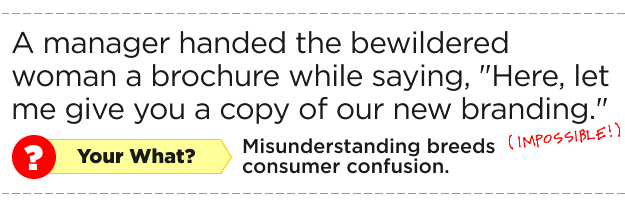
I was checking out a newly rebranded Seattle bank a couple years back, and watched a manager trying to help a woman understand the differences between personal and business accounts. As the prospective customer asked her questions, the manager handed the bewildered woman a brochure, saying “Here, let me give you a copy of our new branding,” and walked away leaving her to figure it all out on her own. (The woman placed the brochure on a table and left without opening an account.)
Brand is not branding
The difference between brand and branding is that one is a marketing tool and the other is an action.
Perhaps the biggest mixerupper I hear in business is the use of brand and branding as interchangeable words. Some people also call advertising branding (it’s not even close). Branding is about defining, while advertising is about promoting.
The fact that many graphic designers don’t know what branding is or how to accurately describe it, makes matters worse, particularly because businesspeople expect them to know. Some designers use brand and branding interchangeably, reinforcing confusion instead of providing clarity.
A brand is a thing (noun). Branding is an action (verb). This is more than just persnickety semantics—it’s about fundamental understanding of a core marketing tool.

What is branding?
Branding is the act of creating a brand. The process involves positioning your company or product in the market (carving out your own place), devising brand strategy (how you will reach your goals), creating your name (your verbal identity), designing corporate identity or product identity (your visual identity), writing brand messaging (verbal and written tone), and setting brand standards (how you keep your brand consistent and strong).
When branding (also called brand development) is completed, most businesses (when they’ve worked with an experienced professional) will not have to undertake the branding process for roughly 10-20 or more years. In the life of a 50-year business, branding the company occurs only 2-3 times total.
When a company’s brand becomes outdated in 20 years, then you may once again need to take on the branding process. If you create new products or launch new companies, you get to enjoy the exciting process of branding on a more frequent basis.
Once the branding process is completed, the word ‘branding’ has no continuing relationship to your brand (unless you work with cattle).

What is your brand?
Your brand is the result of the branding effort. Your brand describes who you are and what you do by use of visual identity, verbal dialog and tone of actions. It is utilized for virtually all of your marketing communications. It is how people identify, know and remember you.
How knowing the distinction helps your business
A critical branding concept to embrace is that we are not creating a made-up story or spiel. We’re creating a real marketing communication tool which, when wielded articulately, can empower your entire organization to communicate with greater purpose and clarity. Knowing this enables people to be well-informed, and to impart better understanding, which leads to less confusion, clear communication, and better customer service.
Understanding the difference between brands and branding helps you net a stronger brand because you will be more personally invested the brand development process. Your understanding also helps your employees grasp the full significance of the brand, so they learn how to best utilize it in marketing, selling, and supporting your goals and initiatives.
1. Find a brand development firm or designer who truly speaks and understands the language of branding.
2. Listen to your brand consultant. If they are good, they will listen to you.
3. Take time to consider the brand strategy questions.
4. Be truthful – don’t hold back.
5. Expect your brand to revolutionize your marketing, but have patience – it may take time.
6. Don’t take your brand for granted. It can be the most powerful marketing tool you will ever have.
7. Inspire your people to believe in your brand, because it is true—your brand is you.
8. Be sure your brand embodies your vision, speaks in your voice, and reinforces your actions.
9. Stay true to your brand, and your brand will stay true to you.

