We are a society full of masks. Some masks are fun, some are for protection, while others are designed to help us hide. Some companies unwittingly mask their true brand. People do it too. The things is, valuable connections occur when we are true to both ourselves and others.
We are taught how to mask ourselves from an early age. Who teaches us how to remove the masks? For some, it’s a slow process of becoming comfortable with reality. For others – particularly those who see value in connection – short order wholesale change makes the most sense.
We wear masks all over our bodies (clothing, makeup, perfume). Masks are used under our arms (deodorant). They cover our mouths (protective masks), eyes (masquerade ball), or whole faces (Halloween), and even around our feet (shoes). Obviously, some masks are useful.
But some masks do us more harm than good. Some people use masks in speech, called half-truths and (gasp) lies. Remember when tobacco advertising said smoking was essential to social prominence? The path to romanticizing a product doesn’t need to include any deceit. There is almost always a real factor that contains appeal.
We all want to be excited by our advertising. We want our brands to outshine all competitors. All it takes is great creative people wrapping their imaginations around a compelling truth. Of course, they must be capable of finding that truth.
When creative professionals or companies start believing in promises made to manifest appeal through false hopes, that’s the top end of a downward slide. It’s when they add a mask into the mix. And it’s completely avoidable.
With a lifetime of masking ourselves, it is no wonder businesses often don’t know how to brand with any degree of integrity. Instead, companies often brand for who they want to be rather than who they are. There’s nothing particularly wrong with this, unless (as is often the case) the presentation of who you want to be misrepresents who you are. That’s how empty promises are made.
The truth is, people want to know who you really are. They want to know what you believe in, what you care about, and how you will treat them. Being honest and up front about this – not hiding behind any masks – is the more likely path to connection and good relationships.
As you brand or advertise, think about how you would present yourself to a new friend or love interest. That kind of bold honesty is exactly what is needed in your brand.
How many great relationships are built on half-truths? How many solid foundations are built on trust and honesty? Which do you want your brand to embody?
My vote is on the latter, on articulating who you are with absolute integrity, so the people who you most stand to benefit can know you are being true, and can believe in your brand.
When I tell new acquaintances I do branding, they often think it means I make up fictional stories to bamboozle unsuspecting minds into falling for fake value, because somehow that is the reputation this industry has managed to build. We have never worked that way. Train of Thought is all about crafting real, compelling, true stories with which people relate because there is real alignment and harmony. That’s been our focus since day one, yet this approach is not universal in graphic design or advertising.
Ever hear of spin in PR and advertising? That’s most likely where design gets the reputation of faking fabulousness in the service of sales. I’d like to set the record straight. Thus, here is a list of 10 things great brands are not:
1. Fiction
2. Image
3. One-sided projection
4. Empty
5. Innocuous
6. Unimportant
7. Outdated
8. Cliche
9. Predictable
10. Pointless
Bonus Not: Lacking integrity.
If your brand is any of the above, it may not be performing to potential. If that’s the case, try shoring it up, or try something new.
If you work at a large company with strong brands or a startup with no brand, to create a successful brand, you have to be capable of being a champion. To do that, you need smart brand positioning.
What if you have a great idea, but no authority on the topic? You must go get informed in a manner that helps you embody the most informed person in your brand’s area. There are no two ways about this, no shortcuts. You need the credentials and experience. If you can’t get those, you will need endorsements of those in authority. In order to get their attention, you will need some credibility of your own. If you’re doubting this, think about when you were a kid, when a classmate made some outrageous claim. What was our unfailing reply? Prove it.
Positioning Dilemma 1
Say you want to position yourself as an expert in women’s nutrition championing a new brand of foods aimed squarely at women. Sure, it’s a noble and worthy cause, but you lack relevant experience. Guess what happens when you start raising awareness? You will have potential opposition from doctors, dietitians, nutrition counselors, and anyone else with a strong opinion.
Granted, your experience may be unique and valuable, but will it be enough for you to speak with authority to the needs of your market? It might be, particularly if your unique experience relates directly to what you want to do. At some critical point, however, you will be asked to prove it.
Positioning Dilemma 2
Let’s think about it another way. Imagine you want to model for running shoe manufacturers. They want top runners, and fit average joes. And let’s say that you, in fact, are not fit and are not even a runner.
What would you be then? You would be a poser and an outsider, the antithesis of the proof people need to see in order to believe. You would lack the credibility needed to get any manufacturer’s attention, much less their ad agency, and you wouldn’t be able to relate to the market. In order to reach your goal, you would have to become a runner and get fit, which could take years. (Of course, you might be up for it.)
Brand Positioning Oversimplified
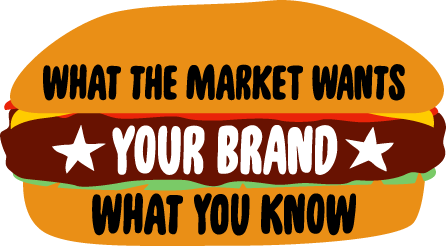
If you are like many entrepreneurs, you want to start a company or brand because you have something unique to bring to market. All you have to do for good brand positioning is make a sandwich.
The top slice of bread is what the market wants and needs, and the bottom slice, the foundation, is what you know. Your product is the middle, the heart of the sandwich (your brand), the reason people choose it and eat it up. And the condiments, lettuce, and cheese? Oh, that’s pure marketing.
Positioning around what you know will make your job easier. If you have credentials and relevant experience, you have a huge head start. Figure out what people want, match it up with what you can offer, and put in the hard work to make it reality.
Good brand positioning makes the difference between failure or success. Positioning around what you know is a critical step towards the latter.
Brand Positioning is one of the most misunderstood aspects of brand development. The purpose of a brand positioning statement, surprisingly, is not about staking a claim of the position you wish to occupy in your chosen market. That approach misguides people because where you aspire to be is generally not where you are, setting up the basis for failure when you could instead set a foundation for success.
A strong brand position states an accurate and succinct position of where you stand in the market. It is where you are now or where you intend to be based on real world aspects of your business today.
The problems with many positioning statements range from boastful ambition, to lack of realism, and inflexibility. Not coincidentally, the key to a strong positioning statement is balancing ambition with realism, and keeping a healthy degree of flexibility.
As your business changes, grows, innovates, and reaches a new position, you can update your positioning statement. That’s one reason flexibility is so important. Another reason is simply because you don’t know what you don’t know. A peer may somehow gain a stronger foothold or out-innovate you.
An out of balance brand positioning statement sets you up to fail because it gives people a false sense of who the company is and what it is achieving. It also misinforms key personnel, the brand itself, and marketing elements such as customer service, strategy, messaging, and advertising.
In order to craft a strong brand position statement, you need to have done your homework. You have to know more than just what you are doing. You need to know what the market wants and what the market already has. Moreover, you need to understand the importance of clearly defining your brand in writing right from the outset.
Your brand positioning statement needs to go well beyond stating the basics of who you are. A good statement is brief and concise so that it is actionable and achievable, yet it must be realistic.
A strong brand positioning statement uses inspiring terminology, yet the phraseology must also appeal directly to your target market because one constantly informs the other. You must consider words that might offend the sensibilities or sensitivities of your market. For instance, you would not use the term ‘earth-shattering’ if you are an environmental group. Focusing on inspiring words will—guess what—inspire people to share your vision and spread your word.
There are two types of brand romantics in the working world, the believers and the paycheckers, and most every organization has both in their ranks, playing the role of inherent marketer.
The good romantics, those who help companies make millions and feel good about it, know how to craft reality into compelling stories people can connect with. The poor ones on the other hand, are romantics who know how to sell themselves in the course of crafting average actions and stories that average people may or may not connect with. The poor ones place emphasis more on making their sale, less on yours.
Internally, every employee is a marketer in one way or another. Employees are either believers or paycheckers. They are working for you because they believe in the company vision and its products, or they are there simply to collect a paycheck. Paycheckers are masters of disguise, while believers are masters of truth. Paycheckers get things done because it’s their job, while believers get things done and constantly strive for improvement because they believe in your brand.
How Paycheckers Drag You Down
The world is full of paycheckers because there are not many truly necessary and compelling products relative to how many workers there are. Paycheckers do what you tell them. They can say that they believe if you tell them to believe, but true belief is in the blood and the bones, and it can’t be acquired with mere telling or employee handbooks.
Paycheckers drag your brand and company down because their dialog is rarely as convincing as it must be, taking an often invisible toll on everyone’s efforts and projecting that outward like a toxic gas.
What people often do not realize about brands is that they are as much related to subtlety as they are about the overt, as much about the verbal as they are about the visual, and as much about the interactions as they are about the buying action. That means everything they do is a reflection of you.
Paycheckers rarely understand the deep significance of this fundamental difference because they are there first to collect a paycheck and second to represent. They’ve got it backwards, and while the difference is subtle, getting it turned the other way round often requires changing their personal core needs, which can be next to impossible without good psychological work (which you rarely can ask people to undertake) and particularly without leading by example, which I will explain further below.
Of course, everyone needs to be paid, but as a core part of their belief in you, believers understand that nudging brand representation in front of personal needs will yield greater brand value and, as a direct result, greater job security and personal well-being. There is a leap in that equation that requires faith in you. Some paycheckers can acquire it and some can not.
How True Believers Support Success
If your product and vision are among the relatively few great, you already have a head start, and if you already have a staff full of true believers, your head start is massive in nature. Not only can you attract talented people who will believe in you, but your people will give you their best efforts every day, always keeping your brand’s value in mind as a priority in everything they do.
Each person on your team will have the capacity to talk about your brand with a convincing tone, and to act as an ambassador for incoming employees, customers, vendors, partners, and anyone else. They are true believers who understand and believe in your vision and products, and they work every day to help you maintain and improve it by being true.
Believers can’t be caught out because they show their belief in every effort, every communication, every interaction, whether or not the effort is a success, a failure, or somewhere in between. Everything they do and say reflects the romantic side of their personality, literally that professional ethic inside of them, the feeling they have for their own motivation and actions, and how they communicate with the rest of the world about your brand.
How to Convert Paycheckers into True Believers
You might have some paycheckers on staff who you really like, you want to see them succeed, and you believe in their ability to help you succeed. They have done some good work, but you feel like you’re not getting the fullness of their capability. That can mean they have a doubt that needs to be fixed by a better experience, something they need to see and feel in order to develop that critical intrinsic belief about you.
The good news is that some paycheckers can be converted over to true believers. All they really need is to have those parts of their psyche that contain fears and doubts born of interactions reinforced with new interactions that overwrite current beliefs. For some it will be a quick conversion, born of one or two small changes. For others who possess more doubts, it may take time.
Converting paycheckers into true believers is all about making sure everyone around them is leading by example, representing your brand in the truest manner and with complete consistency.
Why You Must Lead Believers by Example
People believe in brands when they believe in the people who create and run them. That means you have to be at your best whenever possible, and you have to be real. You have to embody the positive qualities that people hold dear to their own happiness and well-being. You have to possess an understanding of those factors within your company, manufacturers, distributors, and customers, and you have to be able to represent them in a way that is true to your beliefs. You get out what you put in. You have to trust people, and when you do, they will trust you. Two-way trust results in people giving the best parts of themselves to their work, which shows they love what they are doing in helping your brand succeed.
This is where objective introspection becomes paramount. If you are a leader who is lacking in some subtle way, you may be unaware of how your smaller actions and words effect others. For instance, if you lack trust, or have a habit of utilizing belittling words, or over-share your personal problems, that can have a direct effect on people’s confidence in you and your organization. And maybe it’s not you, but rather your brand’s lack of outward character that is undermining their belief in you. Remember, your brand is a direct reflection of you.
A strong brand starts at the core, from within you, then extends to your organization or team, and radiates outward to consumers. It is critical to start at the center and build out belief in a radiating manner. When you do that, you can see the brand grow organically, which in turn infuses your marketing with a healthy core, keeping it true and believable, which helps people easily connect with your products.
Here is an example that many business owners overlook: As inconsequential as it may seem, if you have a dirty office, that internally reflects on your brand because it subconsciously speaks to how you regard the people who work for you. It gives people a degree of doubt right at home, at the core, something extra to think about (in a negative way). A quick daily cleaning shows people that you keep a clean house. A clean house equals a clear mind. Brands have a tendency to grow when everything radiating from the core is clean, clear, and overtly positive.
More obvious places where your brand can inspire confidence include your product quality, brand identity, marketing communications, social media interactions, and customer service. All of these are directly influenced by you and your team.
When you bring the same awareness to the all aspects of your brand, from the smallest through to the most visible, people notice it, and it comes through in everything they do, talk about, and buy.
We are all romantics, all marketing to ourselves. When you give people every reason to believe, you appeal to their romantic side, and it will come as a welcome reward that they place their belief in you.
Is it possible to guarantee brand success? Yes and No. Our branding process works. When we are hired to brand a company, service, or product, we know that the process we use has yielded a whole lot of success and happiness. But we can’t control factors outside of our process. All we can realistically do is follow our process and encourage sound business practices for the rest.
Lately, I’ve been rewriting business letters for some clients to help improve one of the factors typically out of our control, and it’s working. They are getting results. (Over time, my hope is that osmosis will occur, and their written communications will improve. When your writing improves, verbal communication often follows suit.)
My approach to successful branding is a simple process:
1) Plan as much as possible, making sure you get all of the basics down on paper.
2) Design the brand to inspire and connect, while adhering to the plan.
3) Market with integrity, staying true to market needs and brand characteristics.
Does this formula guarantee success? Nope, however, I guarantee that if you don’t do these things, your chances of failure will exponentially increase.
People ask for guaranteed brand success, but a guarantee of success is impossible because there are factors outside our direct influence. For instance, we can’t control how a company does business, how they follow up with customers, or product quality, yet all of those and more factor into overall success of a brand.
The big surprise is that many companies fail to do all three of the above critical steps as described.
• They may do some planning, but not all of it, or they may skip a critical step of planning such as brand positioning.
• They may steer the design towards personal preference rather than strategically connecting it to the market. Of course, we have ways of steering it back on course.
• Companies often market without integrity, creating fictional (let’s say ‘hopeful’ or ‘wishful’) stories rather than compelling truths. This is why people are now suspicious of advertisements.
One truth that reigns supreme in branding and marketing is that repeating what has previously failed will yield failure, but following a proven process that works stands a great chance of manifesting brand success.
This post reviews some common branding questions and answers. If you have branding questions of your own, please send them via our contact page.

Q: What is branding?
A: Branding is the process of creating a brand. Once the brand is created, branding is over.
Q: What steps are included in the branding process?
A: Branding is an 7-step process. It starts with your product or service as a concept, and continues with brand positioning. Next is brand strategy, followed by brand naming. After your strategy and brand name are solidified, we design your brand identity and write your brand messaging. Finally, we craft a series of documents, called brand standards, that succinctly communicate how to use your brand for maximum success.
Let’s summarize the 7 branding steps:
1. Product Concept
2. Brand Positioning
3. Brand Strategy
4. Brand Naming
5. Brand Identity
6. Brand Messaging
7. Brand Standards
Q: What is next in the branding process?
A: After the brand is created, branding is complete. There are no more steps until the process is undertaken again, usually 10-15 years later. Sometimes the period of time between branding efforts can be shorter, especially when a company direction changes.
Q: If I am promoting my brand, isn’t that branding?
A: No, promoting your brand is centered around marketing, most often in the form of advertising.
Q: If I am building my brand, isn’t that branding?
A: No, building your brand is, well, building your brand. In short, it’s sticking to your guns so to speak, following your brand standards, reinforcing what has already been created, and promoting it.
Q: What about my website? Isn’t that branding?
A: Your website is part of your brand identity, yet also may be used as an advertising medium, and even as your store. Just as brick and mortar retailers use advertising to drive people into the store, we often utilize parts of a website to drive people further into the site. For instance, home page banners might direct people to store pages.
Q: Why isn’t advertising branding?
A: Advertising, when done correctly, has a specific purpose. The purpose can be many things, but it cannot be the creation of a brand, which is what branding is. In order for advertising to be effective, the brand must already exist.
To better understand the important distinction between branding and advertising, consider that advertising generally does not work without a brand already in existence. If you advertise for an unknown brand, what would the result be? What would people remember? What would they identify with? What would be their next step? Nothing. There would be nothing for them to connect with, and no next step.
Your brand introduces and illuminates the product people want. Your advertising stimulates a desired action in the direction of the brand.
Q: Is social media branding?
A: No, social media is marketing. Here again, your brand must already exist for the effort to have marketing value. Marketing is all about forging connection. In order to forge connection, your brand must already exist. Otherwise, there is nothing to connect with. (This is not to minimize the value of personal connection born of social media.)
Q: What about branding actions? Isn’t that part of branding?
A: Yes, we consider Branding Actions to be a critical part of creating Brand Standards (Step 7 above). This is where we define the specifics of how to utilize your brand at virtually every touch point. That means discussing and scripting everything from graphical usage to phone demeanor.
If you have branding questions that require fast answers, or need to create a brand that works, give us a shout.
The branding process is many things to many people. To us, it’s about defining your visual identity, verbal tone, and action character. That last one, branding actions, is perhaps the most difficult to understand because it can be hard to see what we’re talking about until you see an example of it. That’s what this post is about—understanding how your actions define your brand, and how we can help you refine and change actions to provide greater connection.
Word to the wise: This is not easy work. It’s hard work, particularly because it requires a great deal of openness and objectivity. The benefits, however, are well worth the efforts.
I’m not going to mince words here. This work is so hard that it tends to offend one’s pride in their accomplishments. It challenges long-held beliefs, requires a degree of introspection, challenges the concept of what is possible, and asks you to do the one thing that is hardest for most human beings: change.
People and companies most often seek to rebrand themselves after they have either seen great success then watched it dwindle, or they tried branding themselves and watched it fail in an overall sense. In either case, business is suffering, and they need to turn it around before revenue falls any further.
Since this post is focusing on branding actions, we’ll consider that we have already redesigned the visual identity and rewritten the verbal messages and tone.
How do you brand actions? What do we even mean by that? I’ll illustrate a few simple examples below.
Example 1
Imagine that you have brought in thousands of customers and made many millions of dollars for your efforts. The normal human response to this is to take pride in your accomplishment, and to develop an increasing sense of pride in your offering, because it is obviously valuable to quite a lot of people. But there’s a problem with this, because your offering is essentially the same as when you started, only you may not be as hungry after achieving great success. Instead of appealing to people with a ‘can-do’ attitude, you shift to a ‘will-do’ attitude, which is inherently very different. ‘Can-do’ is humble, but ‘Will-do’ is not humble in the least (it’s boastful). Meanwhile your smaller, younger competitors have filled the ‘can-do’ attitude gap that your success left open, and they are nipping at your heels. This subtle shift in action undermines your brand’s success, and little by little it shows up in eroding sales.
Example 2
You hand out a business card or tell people your website address in one breath, while apologizing for the state of it in the next. “This is just a temporary,” or “This is old, but we’re working on a much better one,” or even “It’s not very good.” How many times have you heard (or even made) these types of statements? They are in essence apologies for who you are, the character you show with your actions.
Example 3
Cultivating just the right balance of knowledge and pride for your customer service team is a difficult, ongoing task. Once you achieve success or dominate your market, it’s easy to lose objectivity. Or say you hire someone new and don’t teach them how you got where you are, instead only imparting knowledge of where you are now. Their actions in representing what they know of your brand – the things they say and how they interact with customers in person and on the phone – can be severely undermined without you even knowing it. When your company’s actions have been slightly off the mark for a while, the trajectory can be far off of center by the time you discover it. The way back to excellent connection with customers is by changing your actions.
All of the above actions undermine connection. Changing them is as simple as starting the work of implementing something better, objective, and true.
Branding action is about recognizing beliefs and problems, defining new actions that align with your brand and client needs, documenting them in compelling ways that will actually be read and accepted, and reteaching yourself and your team. Most times, you can’t simply go back to where you began because the reality of now is different from when you started. Instead, you have to find the sweet spot in between that represents who you truly are. The key to that effort’s success is in trusting the people who are helping you change.
Psst, lean your shoulder in. I’m going to tell you a big branding secret that graphic designers and branding firms (like ours) keep safely tucked away in their minds, away from clients, away from you. Are ready? Here it is: There’s no such thing as branding. We made it up. We talk about it, promote it, teach you all about it, and do the powerfully inspiring work of defining the core character of your company that is branding. But yeah, branding doesn’t exist.
How can that be? Well, I’ll tell you.
When graphic design was in its infant years, it was all hand-painted, hand-drawn, and personal. It was the craft of artists, and as with nearly any artists trying to carve out a living, it was by no stretch of the imagination a way to earn a good living. People got by, did okay, but they were never considered professionals in the way that a doctor or lawyer might be, and they put in long hours to barely eek out enough to eat and pay the rent (and sometimes they couldn’t). There were a handful of good designers back then, and many average ones (a lot like now).
So how do you make a struggling existence into a comfortable, highly profitable one? You create branding. You might think that just saying, “We specialize in branding,” wouldn’t be enough to allow a graphic design firm to succeed at branding. The truth is, merely saying it is enough, and here’s why: relatively few businesspeople (and few graphic designers) actually know what branding is.
How can that be? Think about this for a second: If I ask you, ‘What is scorting?‘ How would you answer? You can’t provide an intelligent answer because you don’t know what it is. But I made it up, so I can describe it however I like. If I describe the service well enough, really sell you on it, your business will have to do it because you will know that all of your competitors are doing it too. It’s just like branding, except that branding has been in business vernacular long enough that it now has taken on meaning.
Where did branding start? On cows, literally. Cattle ranchers branded their cattle with a mark (well, they burned a scar with a hot iron) to show which cows were theirs and protect ’em from rustlers. Then, along came business savvy (hungry) graphic designers who adopted the practice for businesses (except we used ink and now computers).
Branding has created a separate category for design firms, and those of us who took up the challenge to do it well made a better living. We helped businesses connect better and prosper. But if we never promoted branding as a service, people would not ask for it. What they ask for is design. They know design is art, and art is valuable. But branding? What is that?
If I say the word ‘branding’ now, savvy business people know that it is the process of developing their brand. But most people—business people and designers alike—still do not know what branding means. So we teach, inspire, and connect the thoughts.
To many people, branding is a logo. For others, it’s advertising. Some people know branding is about laying the groundwork for how people will receive your brand, your company, or products. Some people think branding is a one-time proposition, while others think of it as something they do every day. Some people refer to their brand as branding.
Here’s the kicker though. Even though the design industry made it up, branding works. If it did not work, you would never have heard of Apple or Starbucks or Nike. There would be no such thing as category leaders because there would be nothing to categorize. You would not know about Wal-mart or Best Buy or Crate & Barrel. Without branding, your laptop or smartphone would not greet you with an Apple or Windows or Android logo. You would never have heard of Google. Chiquita would just be a banana. And all the smaller brands that earn a place in your day wouldn’t be there either.
Even though branding as a practice was made up, it works when it’s true. As with nearly everything else in our lives, your brand has meaning because people attach significance to it. They do that when every ounce of your brand is true. And that’s the real secret.
Want to know more about branding? Read on:
The important difference between brands and branding
Branding in 5 minutes a day
How to have a standout brand
Strong brand launch strategy starts at the very beginning of brand development, and it continually evolves all the way up to launch. As the brand characteristics become clear, so too does the launch strategy. If you rigidly set a launch strategy, then fail to add flexibility to accommodate the changes along the way, your team will get off track.
Staying on track means strategy questions don’t get sidestepped. It’s impossible to set a rigid launch strategy for a brand that does not yet exist. You can have an idea of what you want to do, but as soon as you clamp down on strategy shifts, you clamp down on potential success and limit your team’s vision.
Imagine you’re launching a new brand, and you need an internal document to get your sales team excited about it. If you impose a rigid brand style guide on the launch and sidestep emerging strategy questions, how can you accommodate new characteristics or holes that have been filled during the branding process?
The answer is simple: you can’t.
If your brand launch strategy remains flexible before all of the brand’s launch announcements and materials are completed, opportunities to capture the full strength of the brand can be developed and used to their full potential.
The key to effective brand launch strategy is flexibility. Once you have completed the full breadth of the brand development, then you can tighten the reigns and plan the final roll out.